

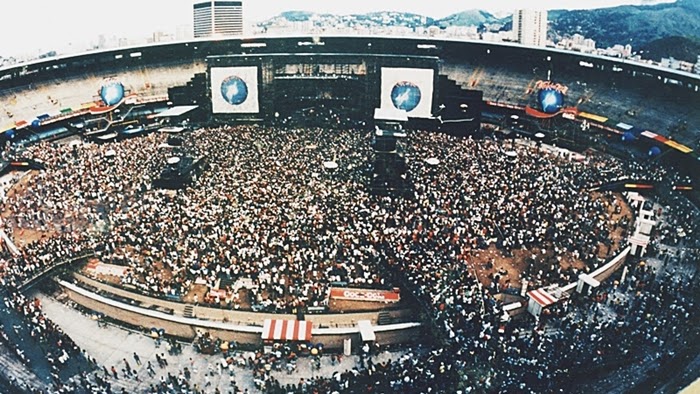
 There’s a moment from January 18, 1991, that I’ll never forget. I was standing backstage at the Maracanã Stadium in Rio de Janeiro—the largest football stadium in the world at the time—watching a sea of 60,000 people packed into what had been transformed into a massive concert venue for Rock in Rio II. The energy was electric, chaotic, and overwhelming. From the outside, it looked like pure spectacle. From where I stood, it was a carefully orchestrated operation built on layers of planning, timing, and constant awareness.
We were protecting Prince during his Brazilian debut, headlining one of the most prestigious music festivals in the world. The festival was being broadcast live to 55 countries, reaching an estimated 580 million viewers. The stakes were as high as they get. And on that night, nothing “bad” happened. No incident. No emergency. No headlines. And that was the entire point.
People often assume protection is about reacting to danger—the dramatic moments you see in movies. In reality, the real work happens long before anything goes wrong. The goal was never to look tough or create a scene; it was to make sure nothing happened at all. Success in professional protection is measured by the complete absence of problems.
After more than three decades in executive protection, I’ve learned that this principle is the single biggest differentiator between professional-level safety and the way most people think about it. Most people operate on what I call the “Illusion of Safety”—the belief that they are safe until something happens to prove otherwise. A professional operates on the principle of proactive awareness.
And here’s the secret: you don’t need a security detail or special training to adopt this mindset. You just need to learn to see the world differently.
The Criminal’s Real Advantage
Contrary to what movies tell you, criminals and other bad actors don’t typically look for a physical challenge. They aren’t looking for the strongest or weakest person in the room. They are opportunists, and they look for the path of least resistance.
They look for three things:
1.Distraction: The person buried in their phone while walking to their car. The family arguing in a crowded public space. Distraction is an open invitation because it signals a lack of presence.
2.Predictability: The person who parks in the same spot every day, takes the same route home, and visits the same coffee shop at the exact same time. Predictable patterns make you an easy target for anyone observing.
3.Inattention: This is different from distraction. This is a general lack of awareness of your surroundings. It’s failing to notice the person who entered the restaurant right after you or the car that’s been behind you for the last ten blocks.
These three vulnerabilities are the currency of criminals. The good news is that you can eliminate them not with force or fear, but with simple, quiet habits.
Thinking Like a Protector: 3 Simple Shifts
Adopting a protector’s mindset isn’t about becoming paranoid; it’s about becoming present. It’s about trading fear for facts and anxiety for awareness. Here are three simple shifts you can make today.
1. Master Your Transitions
Transitions are the moments when you are most vulnerable—moving from your car to your office, from a store to the parking lot, from the sidewalk into your home. These are the moments when we are most likely to be distracted, fumbling for keys, or checking our phones.
The Shift: Make it a rule to have your “head up and phone away” during transitions. Before you exit your car, take two seconds to scan the area. Before you enter your home, pause briefly and observe your surroundings. This simple habit closes a massive window of opportunity for anyone looking for an easy target.
2. Notice Who Doesn’t Belong
In any environment, there is a baseline of normal behavior. In a coffee shop, people are reading, talking, or working on laptops. In a business lobby, people are walking with purpose or waiting for a meeting.
The Shift: Learn to spot anomalies. Don’t focus on faces or try to profile people. Instead, scan for behavior. Who is watching the crowd instead of interacting with it? Who is wearing a heavy coat on a warm day? Who seems to have no logical reason for being there? Trust your intuition. You don’t need proof to decide that something feels off and it’s time to leave.
3. Break Your Patterns
Predictability is a form of autopilot. It’s efficient, but it’s also a vulnerability. If someone wants to target you, the easiest way is to know where you will be and when you will be there.
The Shift: Make small, deliberate changes to your routine. Park in a different spot at the grocery store. Take a different route home from work once a week. Change the time of your morning coffee run. These small acts of randomness make you a harder target to pattern and force you to be more aware of your new surroundings.
Awareness is a Responsibility, Not a Fear
Back at the Maracanã that night in 1991, our job wasn’t to be the toughest people in the stadium. It was to be the most aware. We understood the environment, we anticipated problems before they developed, and we moved with calm confidence. That’s what real situational awareness looks like.
It isn’t about living in a state of constant alert. It’s the opposite. It’s a calm, quiet confidence that comes from being connected to your environment. It’s about taking responsibility for your own safety and the safety of those you care about.
Once you understand that, the way you move through the world changes forever.
To help you put these principles into practice, I’ve created a free, printable checklist: The Everyday Protector Awareness Checklist. It’s a simple tool you can use to build these habits. Download it for free by joining my ‘Bodyguard Insider’ newsletter, where I share regular insights on real-world safety and awareness.
Click Below to Download Your Free Checklist and Join the Bodyguard Insider Newsletter
Leave a Reply