
Archive for the ‘A Professional Speaks’ Category

Written on September 23rd, 2008 by Hucky

Interview with Leonard Holifield

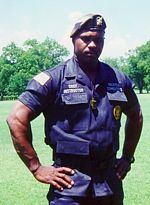
Prof. Leonard C. Holifield, CPS, is President and CEO of the International Academy of Executive Protection Agents, LLC. Known as the Harvard of Bodyguard Schools, he is an honor graduate of ESI – Executive Security International and former chief security officer and personal bodyguard to the former Chief Justice of the Alabama Supreme Court, Chief Justice Roy S. Moore, aka the Ten Commandments Judge. With over 20 years in the security business, Prof. Holifield is one of the most sought after instructors in the United States.

He is the author of SOLO - Security Operations for the Lone Officer (Outskirts Press) and Close Quarter Combat “A Soldiers Guide to Hand-to-Hand Combat” (Paladin Press). He is a frequent lecturer on executive protection, national hate groups and gangs, unarmed self defense and one-man solo security operations. He has been recognized by several national and international organizations; to include Marquis Who’s Who in America, Who’s Who in the World, Who’s Who Among Executives and Professionals, WOMA’s Who’s Who in the Martial Arts and Combative Masters of the 20th Century (Lulu Press). As former Chief Combatives Instructor to the United States Army his work in the field of hand-to-hand combat has been featured in major military publications to include Army Trainer, Soldiers, KORUS and Military Police magazines. A former military police officer and highly decorated veteran of the Gulf War, he was credited with capturing the first Iraqi POW during Operation Desert Storm. He is the president and founder of the International Sikaron Karate Federation and holds 3rd, 6th, and 10th degree black belts in Judo, Hapkido and Sikaron Karate respectively.

BGC: How did you get started in the Executive Protection Field?  What  was your very first assignment?
(more…)

Written on August 25th, 2008 by Hucky

Interview with Bruce Alexander

BGC: How did you start working in the Executive Protection field?

BA: My background is in the military. I was stationed in Germany. There was a lot of terrorist activity being carried out by the Red Army Faction against U.S. military and executives overseas. I was selected to begin specialized training to protect these high-risk individuals, and worked my way up to Protective Security Detail Leader. I was the supervising Close Protection for two General officers at both their residences and offices at military Head Quarters.

BGC: How has Executive Protection evolved over the past 25 years?

BA: In my opinion, the biggest changes are due to two specific events:

The 9-11 attacks and the entry of the U.S. into the conflicts in Iraq and Afghanistan. Let me explain. Before 9/11, there was always an understanding that top U.S. executives in the private sector and government officials were at some risk. Kidnapping was the primary threat, and it was most risky for these individuals outside of the U.S. – particularly in Latin American countries. After 9/11, with the attacks on U.S. soil, we all realized, tragically, that Americans are vulnerable at home as well as outside the country’s borders. The need for protection against terrorists educated the general public as to the notion of executive protection.

The conflicts in Iraq and Afghanistan created a transition from more “traditional” executive protection, to more “tactical” executive protection. So in the past 8 years or so, there has been an expectation that an EPS will have a strong military background and experience with weapons. However, that is changing. Blackwater, the largest provider of personal security details to U.S. diplomats in the Middle-East and high-conflict areas, is transitioning out of that business, as the need seems to have diminished significantly.

While tactical skills are important, the trend is now swinging back, and more traditional skills are needed-particularly to meet the needs of corporate executives, celebrities and professional athletes. By the way, I’d really like to give kudos to Harlan and Bodyguard Careers for educating the general public, and bringing attention to the subject of the dire need to protect these pro athletes, who I think have always been extremely vulnerable.

Once the U.S. pulls out of Iraq the “tactical” EP opportunities will be diminished and I think we can expect a proliferation of individuals trying to transition into more of the mainstream protective services. The pool of talent will be much larger, and I think there will be a greater acceptance and understanding of those “tactically-skilled” EPS. That being said, it is really important for those with military training and experience to understand that OTHER skills that are needed to land the contracts should not be overlooked. Clients and employers are going to be able to be extremely selective, and will be looking for the top resumes. I think we’re going to see a drop in earnings, too. It won’t be like it was in the period after 9/11 when the pay was incredibly high for this type of work.

(more…)

Written on July 22nd, 2008 by Hucky

Elijah Shaw

Elijah  Shaw is the President and CEO of Icon Services Corporation. Entering into its 10th year, ICON is a full service, security and investigative agency, specializing in Executive and VIP Protection. With 15 years in the industry, Elijah’s company services corporate executives as well as celebrity clients which have included Usher, Naomi Campbell, Michael Bolton, and rap star 50 Cent. With tours of duty that frequently take him across the globe, Mr. Shaw acts as a personal bodyguard to these artists providing close protection and security consultation and staffing worldwide.

Elijah has received advanced bodyguard and executive protection training from prestigious associations such as Trojan Securities International (TSI), R.L Oatman and Associates (w/ASIS), and Elite Protective Services and currently acts as an guest instructor with TSI teaching a course on Celebrity Protection.

BGC: It is interesting to note that you don’t have a military or law enforcement background. What drew you to the Executive Protection industry?

ES: I “stumbled” into this work. It was something I was doing to pay for college. I took a job working as a nightclub security guard (bouncer) to pay for college. I wasn’t the biggest guy in the group, but I had an innate ability to talk to people and manage situations. Because the owner liked me and I had the right attitude I worked my way up from the back door guy to the Head of Security.

BGC: What was the very first “celebrity” detail you worked?

ES: It just so happened that a celebrated sports figure owned the club, Well, after working my way up through the club, the owner would put me on personal details. He had alot of interaction with the public, so he didn’t want that “tough-guy security” approach. He needed someone to finesse sticky situations and I had good problem-solving skills. Once that assignment came to an end I was basically back at square one. I knew it was important to be well-rounded, so I worked every aspect of protection you can think of; uniformed security guard to undercover department store theft prevention – Anything to gain further training and experience in the security industry.

BGC: What was the worst mistake you ever made on a security detail? (Behonest! Our readers learn from the missteps of the seasoned pros!)

ES: I remember working with this guy who I thought was really nice and had great credentials. His background was in law enforcement, and he was very personable. I had a celebrity detail come up that I couldn’t work, so I thought I’d give this guy the opportunity. When I called the client the next day to see how it was working out, she said that he was nice, but at the star-studded event they attended, he would make the client stop so he could have his picture taken with celebrities!! He was completely star-struck. I was on the plane that night to replace him. The thing that’s important to remember with these celebrity clients is that they don’t want to “notice” their bodyguards. They just want to go to an event and enjoy themselves and should almost forget you are there. There are a lot of guys out there who have an impressive resume, but their personality needs to fit with the client–and you have to earn their trust. I learned that the right person for a celebrity detail can’t be found just by looking at an impressive resume -They have to have the proper mindset to work with a figure in the public eye.

BGC: How has Bodyguard/Executive Protection work changed from “back in the day” when you first started?

ES: The industry has become far more professional, with a great deal of emphasis on training. It used to be rather “loose” in the way an employer would hire a bodyguard. There was a time when the only qualification for a bodyguard was being either a big bouncer from the club, off-duty cop or retired Navy SEAL. It is more “formal” now–including the terms. Executive Protection Specialists is slowly replacing the term “Bodyguard”. But the majority of the public still uses and knows the term “bodyguard” so it’s important for us to make sure we continue to disprove the misconceptions. Quality training is preparing people in an entirely different way, which I think it’s great for the newcomer. One important thing to remember is that a lot of times guys think previous military skills or law enforcement skills are ALL that’s needed to make it working with the private sector. Many times the great skills just don’t fully translate to actually working with executives or celebrities hence the need for specialized training.

BGC: Have you personally worked with or seen many women in the field?

(more…)